What inspired you to start your career in this field?
Watching my grandmother balance family, work, and community. She had 18 children of her own and raised 10 grandchildren while her husband was in the service.
Who was your biggest role model or mentor growing up?
My grandmother. She was a product of the Hawaiian overthrow of 1893 and comes from an extensive line of Native Hawaiian healers. She not only took care of the people on Moloka‘i but also those who would travel from afar.
What’s the biggest lesson you have learned as a woman in business?
It takes a village to keep you on the right path during your journey.
What is your “power outfit” that makes you feel unstoppable?
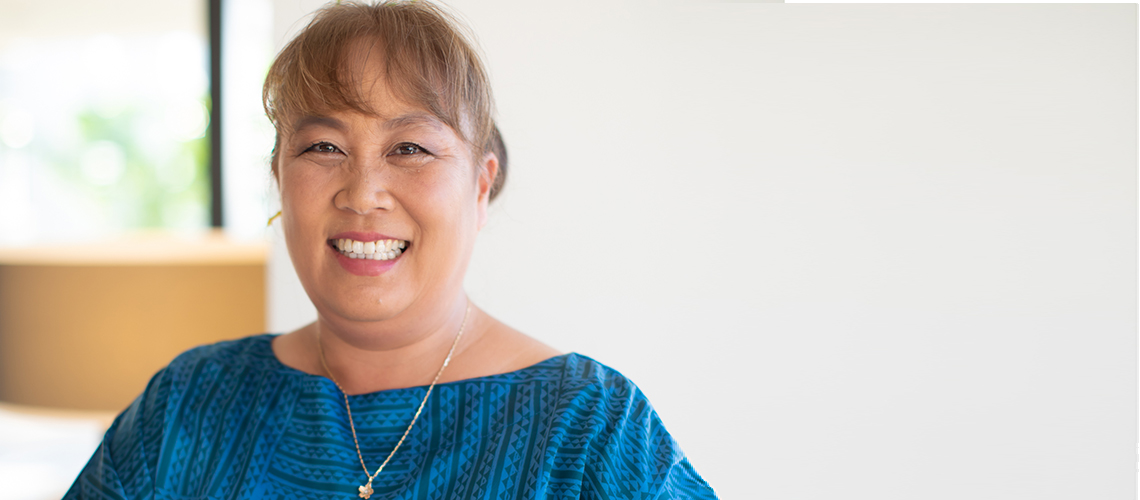
A royal blue holoku or red Hawaiian attire.
If you could host a talk show, who would be your dream first guest?
Michelle Obama. Her beauty, style, charisma, and intellect are stunning. My Idol.
What is one risk you took that really paid off?
Waikiki Health Pu‘uhonua Prison Reentry Program offers statewide inmates a complete support system of information, education, services, and encouragement.
Created in July 2016. Pu‘uhonua (A Safe Place of Healing) was developed by Waikiki Health’s Director of Native Hawaiian Healing Francine Dudoit-Tagupa, who helps inmates create their “Going Home Plan for Success,” a personal roadmap for transitioning back into community and getting connected to appropriate health and social service providers.
According to the Department Of Corrections and Rehabilitation, inmates relapse into criminal behavior due to their lack of a livable wage, safe place to live, and healthy relationships. Our mission is to remove the barriers that contribute to recidivism. Our program allows entrance to all facilities including the Federal Prison through the VOLINCOR services program.
We have 120 partners that assist us with housing (Clean & Sober, Faith Base, Transitional Shelters), transportation, workforce agencies (Waikiki Health employs inmates), unions (carpenters, painters, construction), medical homes (immediate access to care), gift cards, medical insurance (MedQuest), compassionate release, and reunification with family members.
Native Hawaiians and Pacific Islanders have the highest percentage rate in ethnic background of incarceration at 86 percent (2016) vs. 48.2 percent (2025). We know this program works. We are proud to say between 2016 and 2025, we have seen and assisted 6,248 unduplicated individuals, with less than a 1 percent recidivism rate.
What’s your morning routine or ritual that sets the tone for your day?
My day starts around 3 am with prayer and reviewing my schedule for the day with joy and thanksgiving. I lay out my attire for the week. At 6 am, I meet with my assistant over coffee to discuss my week, clients, meetings, and anything that needs my attention. I have an open-door policy, allowing clients and co-workers to stop by and discuss whatever is on their minds. Even if it’s just to say “Hello.” Everyone at Waikiki Health knows my schedule and feels welcome in my office.
What motivates you on tough days?
I really do not have tough days. I have had stressful days. Being around positive people, taking a break, and taking a walk help. Staying positive and being around positive people is a huge plus. Taking a pause from what is causing stress and talking it out changes my attitude. Hawaiian music always gives me clarity, and phone calls from my grandchildren will always improve my mood.
We will always face inconveniences in our lives. If we don’t react to them, we don’t allow them to be tough.