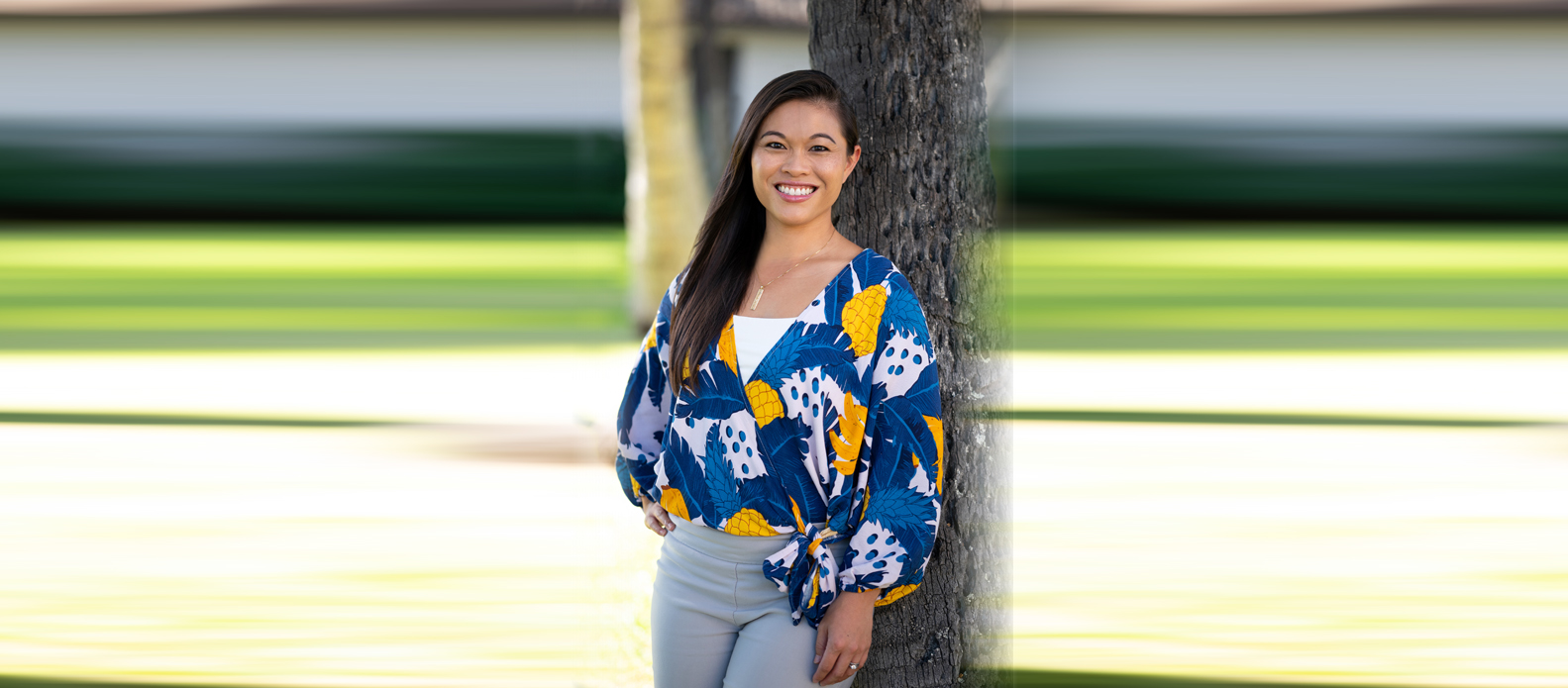
Who was your biggest role model or mentor while growing up?
My parents. I was lucky to have my mom at home full-time when my dad was in the Air Force. She taught me to read in pre-school and always made learning fun. I have fond memories of us playing often, her showing up to every game, performance, and event, and celebrating every birthday and holiday. She later became an interior designer and Realtor while I was in elementary school, and after I graduated college, she enrolled in HCC’s fashion program just for fun. For the final showcase, she created one of the most elegant Hawaiian lines I’ve ever seen.
My dad just retired from a 22-year career at Queen’s as their VP of Native Hawaiian Affairs & Clinical Support Services. He’s always been focused on service, especially to Native Hawaiians. Growing up, he made it clear that grades didn’t matter as much as whether I tried my best. That mindset stayed with me. Since retiring, he’s taken a creative media class at UH West O‘ahu and is now in HCC’s Mele program. When he’s not doing that, he’s traveling, hanging out with my mom, or chauffeuring my 99-year-old grandma around the island.
My parents taught me learning isn’t just important, it’s fun. Learn, work hard, serve others, and have fun.
What’s the best piece of business advice you’ve ever received?
“Leave everything better than you found it” and “Always try your best, even if it doesn’t seem important. You never know when you’ll need those skills.” That came from my grandfather, who led an incredible life and eventually became Hawai‘i’s first Native Hawaiian U.S. Senator. He also taught me by example that if you can lead with aloha and find ways to work with others, not against them, you will accomplish far more.
What’s the biggest lesson you’ve learned as a woman in business?
I’ve learned to be aware of how I might come across and to lean into both the strengths and biases that come with being a woman. One advantage is our ability to build deep, genuine relationships. I take time to really get to know my colleagues, what they care about, who their families are, and that turns into lifelong friendships. I love catching up with them a few times a year just to reconnect.
On the flip side, there are still moments when people perceive assertive women as aggressive, whereas men saying the same thing might be seen as confident. This means we have to work harder to be heard, and that means calibrating tone, body language, and method of communication based on who we’re speaking to.
How do you balance work and personal life—or do you believe in balance at all?
When I started as an admin coordinator, balance was easy. We were a team of five, and I was done with my work halfway through the day and hunting for more to do. A 40-hour workweek was totally normal. Now, everything’s scaled—our team, the complexity of our work, and my responsibilities. I can’t clock out anymore and am always thinking about how to support the team, get everything done, and carve out enough creative space to improve things.
On top of that, I have a wonderful husband of 10 years and a rambunctious and adorable 4-year-old son whom I always want to spend time with. My approach is “go with the flow” with some structure mixed in. I prioritize having fun with my family while still giving my best at work.
I often skimp on “me time,” which I’m working on. What helps is running or walking with my dogs, playing guitar and singing, gardening, reading, or taking 15 quiet minutes outside after getting home—no phone, no noise, just wind through the trees. Sometimes there’s rum and a cigar involved. It’s a nice reset.
What’s the most recent book, podcast, or show that inspired you?
CHIEF of WAR hands down. As a Native Hawaiian, I’m deeply grateful for and proud of everyone who brought that project to life. It was a powerful example of the excellence we’re capable of, and it told our story from our side in a way I’ve never seen before. I cried through so much of it, feeling sadness over what our people endured, awe at the beauty of who we were, and a deeper connection to where we come from. It helped bridge something that’s been lost across generations.